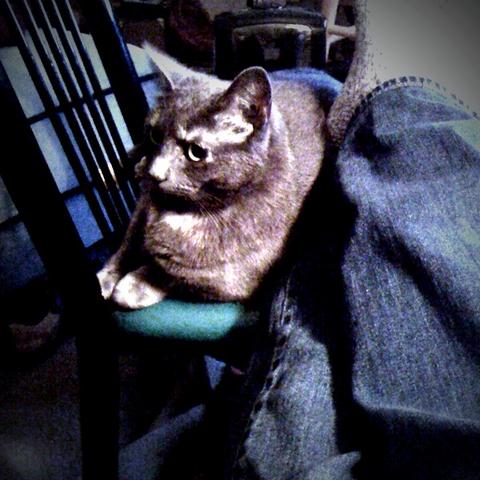
Test post with pic from my iphone
On sensation and elation
This site is, for the most part, a drug-and-booze-free zone. It is also a guru-free zone. Knox grew up in the sixties, a fourth-generation West Coast lad, and came of age in the seventies.
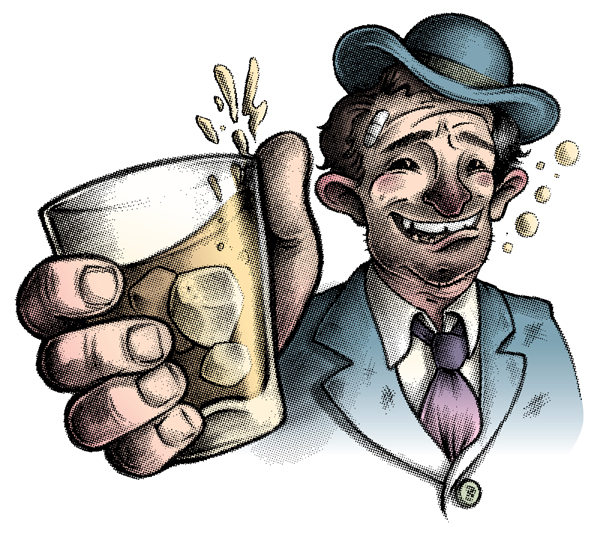
He partook freely in the pursuit of sensation and elation through much of those decades and beyond and has, unfortunately, seen far too many of those closest to him fall into the abyss, too often with fatal consequences. Suicides, overdoses, car crashes, all manners of drug and booze related death has Knox witnessed close at hand. Knox himself has been booze and drug free for seventeen years.
For those of you who still buy into the romantic notion that creativity comes from drugs and/or booze, Knox suggests you listen to the Jefferson Airplane’s Surrealistic Pillow, one of the most musical and sexy and romantic (manifesting the naive and wonderful optimism that was once so identified with the West Coast) albums to come out of the golden era of pop music, and then listen to their Bless Its Pointed Little Head album, a cocaine-and-booze-fueled barrage of live drivel from three years later. If that doesn’t demonstrate the fallacy of drugs/booze=creativity and musicality, write Knox and he’ll send you some more examples.
But be assured that Knox is not anti-drug. Knox is, however, pro-sobriety. Knox has no problem with earth-people getting drunk or high or whatever it is they do on occasion.
Knox is not preaching: please feel free to use any of the drugs he somehow missed in the old days, as well as any booze he failed to drink.
Put on some music! Have a glass of wine.
Pop Down The Years video (acoustic)
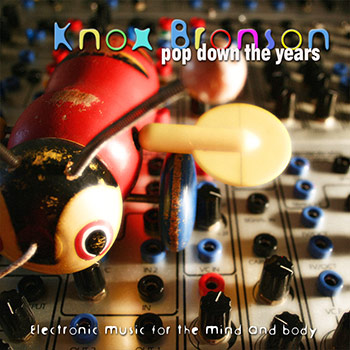
This is the title song to my first cd. The cd version had an orchestral arrangement, my tribute to the Beatles and George Martin. The song is a love song to the music of that era, and to a girl of course. I happen to like this acoustic version I recorded in my living room one night. Video is found footage. You will recognize some of it.
First review of “the seasons” – 5 stars
Mark Tucker
Fame Magazine

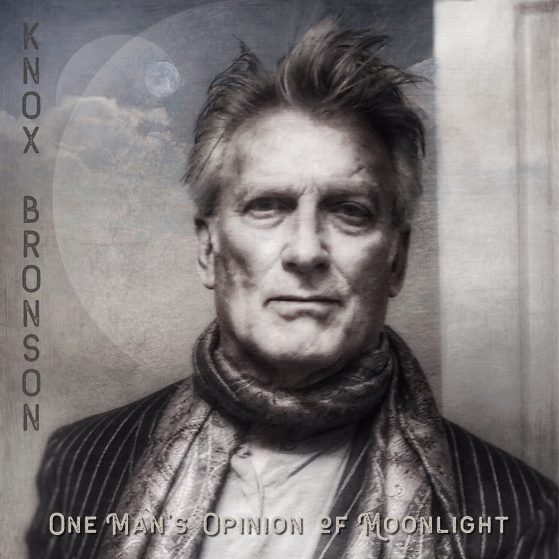
I reviewed Knox Bronson’s Pop Down the Years a little while back (here) and Seasons has followed with gratifying swiftness but also with an almost shockingly rapid maturation. Completely instrumental in a slow languid pace that urges the listener to relax and luxuriate, where Pop was quirky, interesting, and prog-oriented, Seasons is chambery in the Impressionist sense with tantalizing echoes of Eno (Summer of ‘68 uses the intriguing slow hooning of Discreet Music), Peter Baumann (ca Transharmonic Nights), Peter Michael Hamel, a tranked-out Terry Riley, and the more sensual of the electronicists.
The disc contains just four long songs for an hour’s submersion in
intelligent, slow, spare processionals and ambiences. Michael Hoenig
peeks out occasionally from Autumnal Sun, though the estimable German
never wrote like Bronson does, slowly shifting in sound fields,
coloration, and environmental palette. The attention to perfection here
is bracing, resulting in a piece of spacey furniture music, high art
wanting for nothing, content to take its time in seeping through the
speakers and into cerebellums. Mix the hedonism of the Ibiza crowd with
the seriousness of old Brit/Kraut ventures, then add a sprinkling of
the silently uncanny ideas of Vidna Obmana, and you have a starting
point.
Despite the fact that the quartet of songs was composed during a
dark period in the writer’s life, every minute of Seasons sparkles.
Even the moody segments have a shine and glow lifting them above the
melancholy, indicative of the redemption art brings. The entire
enterprise is pensive but never existentialist, remarkably zen in many
ways, unattached to judgementalism, formula, and tradition. A goodly
portion of the entirety is Debussy-esque, borrowing heavily from tone
poem concepts for heady textures and gestures nailing down authenticity
in genteel certainties alongside intriguing ambiguity. Pore over the
progressive, electronica, and ambient catalogues as you will, you’re
not likely to find very many releases to stand with this one.
Oh my, we are live
I impulsively took down my old site. It was done in Joomla!, a content-management system quite popular in certain circles. I was bored with it … some flashy stuff … who cares?
I thought I would go completely minimal. Black and white, nice typographic layout. If you want color, visit my old site “Sun Pop Blue.”
Other reviews of “the seasons” from around the web
Click here: THE BLARG
Knox Bronson “The Seasons” – A beautiful and brilliantly mastered four-track instrumental work that bridges the gap between the orchestral and symphonic, and the subtle digital realm of acts like Plastikman. Each track (coming in around the fifteen-minute mark) represents a different season, and Bronson has somehow managed to rip apart summer, fall, winter and spring, and put them back together in the form of a song. One of the best of this batch.
Mix electronic, classical, ambience and pop and you have the new, innovative piece by Knox Bronson in The Seasons. Even adding that symphony orchestra element to the background, Bronson takes you on a hypnotic trip. Bronson is the singer, songwriter and composer who brings you four excellent installments that run for an average of 15 minutes. All instrumental, the album is one to listen close to with true meaning behind each creation of sound.
On the cover you see an attractive woman unclothed with her legs in the air and arms covering her private essentials. Definitely an eye-catcher and this beauty is actually Victoria Secret supermodel, Amber Myles Arbucci. She can be seen on the back along with inside the contained artwork displayed in different poses. The true essence can be seen from the cover because she seems completely at peace with herself and her body. Her eyes are closed and she lays there on her back without a worry in the world—carefree spirit if you will. The ironic part is that this seductive portrait of Arbucci actually captures the pure emotion of the album. That raw emotion being peace and tranquility is the premise of the record.
The Seasons is just that; inviting you to experience each turn of the seasons one by one. The album starts with “Summer of ‘68” and ends with “The Forever Spring” taking the listener on a magical journey. Bronson offers a whimsical quality along with a strong spiritual well-being that resonates throughout the composition. Each song signifies not just the spirit of the seasons, but also the spirit of Bronson inside.
Knox Bronson
The Seasons
Bullz-Eye Magazine
By Jason Thompson
How exactly to peg Knox Bronson? Perhaps we shouldn’t and just let the music speak for itself. On this album of four extended pieces, Bronson mixes jazz-like passages with electronica, sometimes almost pushing it into a trance realm, but not quite. It’s too sophisticated for that sort of programming, and that’s definitely a plus. What it is definitely is languid and spatial, with “Summer of ‘68” and “Autumnal Sun” being completely wondrous works of music. If there’s a misstep here, it’s only in “Winter Blue” and only because it’s the one spot where the music doesn’t live up to the prior cuts, sounding a little too syrupy at times. But things get back in the groove with the closing “The Forever Spring.” Consider it Vivaldi for 2009, if you like. And if you don’t, there’s still a pretty lady all over the CD’s art in various stages of undress. Ooh la la.
the seasons
The OakBook Interview for “the seasons”
Original article here.
Oakland is the Bay Area capital of art and music. Knox Bronson, a local musician, has spent the last few weeks putting the finishing touches on his latest CD, The Seasons. If you’ve heard his music before, you know it’s eclectic. It’s very 60s. It can also be very contemporary. Regardless of what else it is or isn’t, it’s more often than not the story of his redemption. Here are excerpts from a chat with him:
OB: When is the CD coming out? And what’s the distribution looking like?
KB: I think probably the target date is Feb 14, Valentine’s Day. We’re going to do digital distribution – iTunes, Amazon and other places. I’ll send CDs to CD Baby and places like that. I expect to get them in local stores pretty quickly. The business is changing rapidly.. The business part is always a mystery to me. SMC Recordings, a hip hop label that has distribution with Fontana and Universal, does it for me.
OB: Where are you from, Knox? Are you from the Bay Area?
KB: I’m local. I graduated from Berkeley High school. My family’s been here a long time. I’ve been here my whole life pretty much.
OB: So when did you get into music?
KB: I’ve been a musician since I was .. I started when I was in 5th grade, studying the trumpet. When I was a teenager, I picked up the guitar. I taught myself how to play the guitar with Beatles song books. When I was in high school, I had a French teacher who introduced us to the Impressionists. That’s how I got into classical. I love the Beatles, David Bowie, Pink Floyd. In the 70s, I fell in love with electronic music.
OB: So did you have a career in music?
KB: In my early 20s, I would practice guitar for 8 hours a day, and then it was party time. If you’re partying like David Bowie..
OB: You got into alcohol and drugs?
KB: It got serious. It took over for almost 20 years. Then I got sober in 1990. I was so burnt out. I was about three years sober when I remembered I used to love to play music. I had a synthesizer that someone paid me for some work I’d done in the 80s. I had a Roland keyboard. I started making music again. I started buying gear. I had to learn about recording and arranging, and that’s all I did for years. I was working. But every spare moment, I was doing music. I always heard music in my head, but I always wanted other people to play it for me. I wanted Pink Floyd to put that album out. What happened since I started working on music again — I began starting to get the music again. I have to stress that I’m of the school of thought that we don’t really create the music. It already exists. If we’re lucky, we get to channel it. It’s about learning how to arrange and use the technology.
OB: Tell me about the CDs you’ve done..
KB: The first couple of CDs I did were pretty electronic, very beautiful. Those were– Flight of the Atom Bee and Deus Sex Machina. I then started working on vocal music. And then a few years ago, i started working on The Seasons. I was trying to come back and do a true fusion to combine electronic and classical music and not just overlay one on top of another. I’m very happy with the CD. Three pieces on the CD written at a very difficult time.
OB: Why was it difficult?
KB: I was down in LA, I didn’t have any money. I was staying at a friend’s house, things were very bleak. I’d had to give up my place up here. It was just a weird time. I wrote these pieces. When things get really intense, I write. That’s what I do. It’s my refuge. if you listen to the pieces, you’ll see the progression. There’s a part that gets very.. it’s like a bridge.. bridge out of the darkness into the light. I have a 4th piece — very pretty, dreamy piece. It’s an hour of music — 15 minutes each. It’s about romance.. about getting out of the darkness back into the light. That’s been my life. I spent many years in the dark world and then I got out. It’s been quite a journey. I’ve seen a lot and I try to put it all into my music. Everything I have goes into my music.
OB: What’s your day job?
KB: I’m a designer. I’ve done graphic design for many years. I do a lot of web stuff. I call myself a designer..
OB: How’d you get a Victoria Secrets’ model involved with your project?
KB: We met on MySpace. She sent me a letter saying she liked the music (myspace.com/sunpopblue) especially the excerpt from Winter Blue, which is on the CD. I kept looking at her pictures and I kept thinking I must somehow get her to be on my cover. I sent her my CD.. She really liked it. She mentioned she was building a website. I asked her — this is totally out of line, but would she pose for my cover if I built one of her websites. She said yes.
OB: Your press releases always mention the 60s and the 70s and the influence they had on you.
KB: Back then, there was more time, less economic pressure. There was more room for experimentation. It’s getting better again, but in some ways, DJs and club culture have thwarted.. there’s not a lot of song craft in that stuff. It’s about vibe, hook and melodies had fallen by the wayside, somewhat. But I think that it is turning around. The way they render music now is so compressed and loud that by the time you’re on the third song, you’re suffering from ear fatigue.
Then, artists had more time to develop. But back then, I don’t know how I would have done this. I would have needed an orchestra. Now, I get the choir in my Mac. And I feel music occupied a different place in people’s life. People really believed people could change the world.
OB: But they still believe that.. Look at the singers singing about political change.
KB: I like Eminem. My sons are 25 and 27. I think Eminem is their John Lennon. He’s a very bright guy.
The Coming of the Great Darkness, Pt. 1
My mother cried
When president Kennedy died
She said it was the communists
But we knew better
We were born
Born in the fifties
Born, born in the fifties—The Police, “Born in the Fifties”
Jackie Kennedy cradles her husband after bullets shot by snipers on the grassy knoll blew half his head off. This act of war against the United States, of high treason, changed the course of American history. The assassination, and the failure of our country’s leaders to bring the killers to justice was, and remains, the central fact, the darkness at the core of our American Republic.
I was in eighth grade when John Kennedy was killed. I remember standing in the cafeteria with the whole student body as a teacher told us that John Kennedy was dead in Dallas. I will never forget that day, the shock, the sadness: who among us of my generation will? We loved John Kennedy and the great promise of America, for all Americans, not just the few, that he embodied. If you were not there, you cannot really know how exciting it was—the killers killed so much more than a man that day.
Of course, they had to kill again, not just RFK, who would have, as president, brought his brother’s killers to justice, and Martin Luther King, who inspired millions with his grand vision for racial harmony and economic justice in this country, but many others involved with the original assassination, as well as scores of witnesses, over the next fifteen years.
Our parents, who still trusted the institutions that shaped our nation—government and the media, mostly— told us that Lee Harvey Oswald did it. And then somehow, a distraught patriot managed to sneak into the Dallas Police department and kill Oswald. Many years later we would learn that Jack Ruby was a well-connected mobster with strong ties to Sam Giancana’s organization in Chicago. Ruby died of cancer in jail. Even as a kid, I knew the whole story smelled.
Approximately fifty days after the killing of our beloved President, “I Want To Hold Your Hand” by the Beatles made number one on the US charts. So the pain was masked, but never forgotten.
By 1968, our nation was in full ferment. We were fully engaged in Vietnam; young men were dying for no reason. Our friends who had engineered the killing of JFK were, among other things, shipping massive amounts of heroin from the Golden Triangle to the ghettos of America. Massive protests against the war and for civil rights—this was before political correctness split the left into a hundred pieces—rocked the nation’s campuses. Bobby Kennedy advanced steadily on the presidency. Martin Luther King’s rhetoric and influence had reached a new level of power and influence.
The very next day, Martin Luther King was assassinated in Memphis, Tennessee. For a plausible reconstruction of the plot to kill him, I recommend James Ellroy’s,”The Cold Six Thousand.” (More on that book later.)
On that tragic day, Robert F. Kennedy said:
We can do well in this country. We will have difficult times; we’ve had difficult times in the past; we will have difficult times in the future. It is not the end of violence; it is not the end of lawlessness; it is not the end of disorder.
Later, at Dr. King’s memorial service, Richard Nixon, the always Mob-friendly Darth Vader of twentieth century American politics, leaned over to whisper hello to Jacqueline Kennedy, black-draped in the pew ahead, and received an icy stare in return.
And the powers that be were getting nervous as the sixties came to a close.
While Richard Nixon was planning his political comeback, everyone knew Bobby Kennedy would be a shoo-in for the presidency. RFK was, of course, assassinated on June 5 of 1968. I recommend Ellroy’s book for a plausible reconstruction of how that plot developed. (As an aside, I came across an interesting article the other day about the RFK killing: Did the CIA kill Bobby Kennedy?)
Nixon was elected President. Four years of nightmares followed, although he was forced to do a few things, like create the Environmental Protection Agency, which Bush has now nearly dismantled.
While running for re-election in 1972, Nixon apparently got very nervous about information that the Democrats might have about a loan Howard Hughes had made to Nixon’s brother Donald. A crew was dispatched to burgle the Democratic Headquarters in the Watergate Hotel. This led to the the near-impeachment and subsequent resignation of Richard Nixon as President of the United States.
Interestingly, many of the names in the Watergate investigation were also to be found in any history of the failed Bay of Pigs invasion, thought by many to be the Mob’s attempt to reclaim Cuba from Castro, with JFK’s refusal to supply air support for the invasion to be the final straw, thus sealing his fate.
Right before the infamous eighteen-and-a-half gap in Nixon’s Watergate discussion tapes, Nixon instructed his aide, H.R. Haldeman,
“When you get in these people when you…get these people in, say: “Look, the problem is that this will open the whole, the whole Bay of Pigs thing, and the President just feels that” ah, without going into
the details… don’t, don’t lie to them to the extent to say there is no involvement, but just say this is sort of a comedy of errors, bizarre, without getting into it, ‘the President believes that it is going to open the whole Bay of Pigs thing up again'”
“The Bay of Pigs Thing” according to Haldeman in his memoir, The Ends Of Power, was Nixon’s code phrase for the conspiracy surrounding John Kennedy’s murder. In the same conversation Nixon mentions “Project Gemstone” — intended as “a vast intelligence-gathering and dirty-tricks campaign” against the Democrats and (one would have to say) against the electoral process itself. Given the Republican theft of the 2000 and 2004 presidential elections, and the voter suppression and other dirty tactics of 2006, I sense a pattern.
All of this has been documented by much more serious researchers of recent American history than myself.
My obsession, if you will, has always been more about the spiritual betrayal of our American democracy.
I was called, by my newspaper reporter friends back in the day, paranoid when I would try to point out the non-coincidences surrounding Watergate, Nixon, the Bay of Pigs, the JFK killing, as we sat drinking at the M&M at 5th & Howard in San Francisco. Years later, the same reporters would say, “You were right.”
I still am accused of wearing a tin-foil hat at times. In truth, I look at the facts as best I can gather them and sometimes I must make intuitive leaps … over time my guesses have proven to be correct, every time. Not bragging: I get no pleasure out of seeing the things clearly, I can assure you.
I’m no “truther” – I don’t believe 9/11 was an inside job, though the gang of crooks in the White House was so busy planning the plunder of the treasury and the nation’s resources and probably the invasion of Iraq that they ignored the explicit and well-documented warnings provided to them. The simple fact is that they did not need 9/11 to use as a pretext for invading Iraq, suspending the Bill of Rights, or creating the modern security state in which we now live.
It’s funny … I thought this piece would be a few paragraphs. The following is what my original post was to have been, in my conception of it, anyway.
As many of you know, I used to drink. I drank for all kinds of reasons, I guess the main one being it sort of … runs in the family. I drank over Nixon and his evil machinations for years. In 1990, something happened and I was able to leave the drunk world behind. I’ve had many adventures since then and I’ve been able to think a lot more about the what they did that day and what they’ve been able to do since. The killers did a great job.
I shouted out
Who killed the Kennedys
When after all
It was you and me
-The Rolling Stones, Sympathy For The Devil
Some years into sobriety, I made the acquaintance of an ex-mobster who had managed to get out of the Life alive, and who later got sober himself. He told some great, funny stories and his transformation from a violent man into man of peace and true generosity was a great testament to the power of God. There are many such stories, of course.
Rod had been sober about thirty years when I met him. For some reason, he took a liking to me.
I ran into him one night about six years ago and he gave me the usual kiss on the neck and said in his gravelly voice,”How ya doin’ kid?”
And I said,”I am wondering if you can settle an argument I’ve been having for ten years with my sponsor.”
He said,”What’s that?”
I said,”Well, were you still affiliated with organized crime when John Kennedy was killed?”
And he said,”Yeah.”
I said,”Well, among your associates, who did they think killed him?”
And he got sort of a far-away look in his eyes and after a moment, a long moment, and then he focussed back on me, smiled coolly and said,”Are you having a nice night, kid?”
Click here to read part II of The Coming of the Great Darkness.
The Coming of the Great Darkness, Pt. 2
” …fairness, justice, and freedom are more than words,
“So if you’ve seen nothing, if the crimes of this government remain unknown to you then I would suggest you allow the fifth of November to pass unmarked.
“But if you see what I see
if you feel as I feel,
and if you would seek as I seek,
then I ask you to stand beside me one year from tonight …
—V, V For Vendetta
So we are talking about the killing of President John F. Kennedy, the fact that his killers were never brought to justice, and the feeling that we are now, as a country, living in Bizarro-world, where everything is the opposite of what it is supposed to be.
We left off in Part One with my ex-gangster friend replying,”Are you having a nice night, kid?” when asked him who his associates in the mafia thought had killed JFK.
I smiled, but was silent, totally focussed on him and whatever he might say next.
And he said, finally, looking at me levelly,”I could tell you a story. I don’t like to talk about it that much. I knew at least fifty people who were involved who have been killed …”
He went on to say that Sam Giancana, the country’s top mobster, had ordered the hit and that he himself had been invited to take part in the operation but had, for reasons he did not share with me, declined.
Needless to say, I was nearly ecstatic. After thirty years of the study of this great dark act at the heart of American history, I believed I was getting close to the truths at the core of what William Burroughs called
“The last and greatest betrayal of the last and greatest of human dreams.”
Over the next couple months I talked to him a couple times on the phone. At one point I asked him if we could get together to discuss the JFK killing.
He said:
–No, we won’t be talking about it anymore. Some people in Texas told me not to talk to you about it.
[I’ve often wondered about this. Do you think he called up “some people in Texas” and asked permission to tell a young friend about the darkness at the heart of the American century? I truly welcome a feasible explanation. I am just having a tin-foil hat moment with this.]
I was quite disappointed, but I didn’t give up all hope.I ran into Rod a few weeks later. He gave me a hug and kiss on the cheek as usual.
–Hey, kid, how ya doing? he smiled.
We went through the pleasantries and then I said
–Rod, I know they suggested you not talk to me …
And he said sternly
–They didn’t “suggest.”
I got his meaning and continued
–Well … could we talk about other things?
–Like what other things?
I said
–Have you read Ellroy’s books?
He said
—The Cold Six Thousand.
I asked.
–Did he get it right?
–It was a work of fiction.
–Yes, but did he get it right?
–He can’t prove it. If he could have proved it, they wouldn’t have let him write it.
–Why do they care so much after all this time?
–It is a part of history that they do not want revealed.
–Well, how did they get away with it then?
He leaned toward me and said quietly but emphatically,
–They kill people.
–But it was an act of war.
He said nothing to this, but a sly sad smile spread across his face and he just looked me without blinking.
Agitated, I said
–Well … how deep does it go?
–Kid, you’ve got to understand something. We’ve always been part of it. They use us for things they can’t do. One time in the early sixties, there was a civil rights caravan heading for Reno from California, to unionize workers and the powers that be wanted them stopped. So about fifty of us got on Highway 50 up in the mountains with tommy guns and stopped the caravan, told them to turn around or there would be a massacre. They turned around and went home.
Which prompted a question from me, for which perhaps there is no answer.
–In that case, where is the dividing line between … you know … the legitimate corporate world and the mob …
Rod shook his head in resignation, said
–It used to be pretty clear-cut, but now it’s all fucked up … [this was around 2002 – the era of W]
Then he could see the reaction I was having to all of this.
Overload.
He said, gently
–Just remember, Knox, when the going gets tough, the Devil eats his own.
Then he repeated it
–When the going gets tough, the Devil eats his own.
I nodded, taking some comfort in this assurance. He smiled. I had to run to take care of a few things and said
–Thanks, Rod, I’ve got to run. Talk to you soon & blah blah blah
He bid me farewell and Godspeed.
It was the last time I saw him alive. He was diagnosed shortly thereafter with terminal cancer. Before he died we had a few conversations.
I told him that a number of our mutual friends thought he was pulling my leg, making it all up.
He sighed
–They just don’t want to know.
He kept saying I should come visit, but by this time, I was on the lam in Hollywood.
After I got back from my first trip to Las Vegas, a city I had long associated with the killing of JFK … I had taken three HoneyBun girls, my voice coach and his boyfriend, ostensibly my partners in a plan to bring spanking kits to Western culture, to the International Lingerie Show where we had a booth … Rod couldn’t wait to hear my reaction to the city.
I had just finished reading two books, The Money and the Power, the Making of Las Vegas and Its Hold On America and Double Cross: The Explosive, Inside Story of the Mobster Who Controlled America, about Sam Giancana, wherein Giancana described the JFK killing as a coup d’état (“Nobody goes up against the Outfit and wins.”)
I was not prepared for Las Vegas. I don’t think anything can prepare one for Las Vegas. The trip and the books put me into a funk for a week. I told Rod so.
–Aw kid, he exclaimed, don’t let them intimidate you! It’s just another town with a hustle!
And, as he often did, to make sure I understood, he repeated
–Don’t let them intimidate you … it’s just another town with a hustle!” He laughed.
Rod died not too long after. Unfortunately, I never made it to see him again.
Bullfrog on “Pop Down The Years”
Knox Bronson is a Bay Area-based singer-songwriter who has used this release as a way of revisiting the 60s and 70s and making a tribute to the old school way of composing and producing. More than that, he’s looking to re-invoke the days when music seemed like the doorway to all things right and beautiful.
He has done all the programming work himself, written and arranged the songs and sung them too (with some help from chanteuse Angie Harnell…note to Knox, next time, give her a bit more space to strut her stuff). Sometimes, when an artist gives himself all the tasks, he loses sight of the goal and the album’s focus drifts. Not so here; Bronson keeps his inner eye on the ball and delivers a piece of work that harks back to good times of Donovan and the Moody Blues, but maintains a foot in the here and now.
Bronson is the kind of guy who’s seen it, done it and even has the t-shirt, but gave it back. He is literate, mature and thoughtful and this comes through in spades in this release. He’s here to speak his truth in quiet, authoritative terms.
Bronson has a voice that reminds one of David Bowie in his good years. He doesn’t have an especially melodious voice, but it is pleasant to listen to, authoritative and solid. The music and lyrics flow around our ears, drawing us into another place.
The only cover song is “Celeste”, originally written by Donovan (and done better by Bronson), but we are treated to “Pop Down The Years”, an evocation of the days when the intellectual and the psychedelic could co-exist in the same song.
Summary: Get this album. For mouldy oldies, this music is a throwback to the “good ol’ days”. To the young and hungry-for-the-new, this release will come as a revelation.
Press release for “Pop Down The Years”
Dedicated to bringing back the golden era of pop songcraft via a unique mix of rock, electronic and classical influences, Bay Area based singer-songwriter Knox Bronson has long subscribed to the whimsical spiritual notion that “we don’t write the songs. They already exist. If we are lucky, we are able to go down below where the music is and bring fragments back—and then more fragments. And with a little luck, patience and discipline, we end up with something worth sharing.” The compelling songs that comprise his latest album to Pop Down The Years, have been swirling around and inspiring Knox have manifested themselves with a sound that’s something like The Beatles filtered through Bowie, with some Donovan, French impression composer Claude Debussy and the legendary German electronic band Kraftwerk added for good measure.
If Knox’s unique approach seems like a throwback to 60s and 70s–a tribute to the old school way of composing and producing–make no mistake, it’s purely by design. He came of age in those days and can remember a time when music mattered, the roots of rock were blues and the Brill Building and Tin Pan Alley influences ruled the charts. After recording but not officially releasing two previous classical/electronic driven albums—including Deus Sex Machina and Flight Of The Atom Bee, a companion piece to his novel Flapping—he returned to his lifelong love of pure, heartfelt songwriting. His goal: to maintain that level of composing while blending in and exploring the unique tonal colors made possible by today’s incredible technologies. The result is a timeless collection that, first in his mind and now in the spirits of music fans everywhere, brings back the magic that’s been missing in pop music for too many years.
“Just as the title track is a love song to both that era and a girl, the idea was to make something beautiful that people can enjoy listening to as much today as ten or twenty years from now,” says Knox, a veteran of the Bay Area dance club and café performance scene. “It goes against the grain of ‘flavor of the minute’ that has been part of pop music for a long time. I’ve always loved working with electronic and orchestral sounds, and while I didn’t start out with an overall concept, I always made sure to get out of the way of the song so that the honesty and emotion of each could shine through.”
While Knox did all the arrangements and orchestration for the backing tracks on a Macintosh and played most of the instruments on Pop Down The Years, his sound is greatly enhanced on certain pieces (such as the Bowiesque “Old Man Cold Man”) by drummer and percussionist Shoji Kameda, well known for his work with the popular jazz fusion group Hiroshima. The project was co-produced by Knox’s longtime friend Andy Crisp, a veteran studio musician who has worked in Los Angeles, London and New York. Knox was building some powerful musical steam by mid-2007 when he hit a creative block and the project briefly stalled. He knew the songs were strong but wasn’t quite hearing the magic for which he was striving. Crisp’s input and development contributions, as well as his idea to bring in live drums and soulful vocalist Angie Harnell, brought life back into the sessions; Harnell appears on four of the nine songs. Another factor in catapulting Pop Down The Years into its ultimate form was the expertise of veteran mixer Charles Stella, who has lent his brilliant production skills over the years to albums by everyone from Norah Jones to Thievery Corporation and the Brazilian Girls.
The album’s overall diverse vibe is captured by a few key tracks, beginning with the trippy and summery, Beach Boys meets Europop bubblegum tune “Hey Little Earthgirl”; an outer-space love story with intergalactic space imagery, the cheery tune chronicles the journey of leaving one’s home solar system to find true love. The metaphysical mini-suite “Old Man Cold Man,” which Bronson said was his first attempt at arranging for string bass, cello, violin, and frog, is a tone-poem, an other-worldly response to David Bowie’s song “Bewlay Brothers” itself an allegory detailing the closing down of the 60s in another dimension, while the propulsive “3 Seconds Before Maia Smiled” (whose meaning is purely up to the listener’s interpretation) is in the permanent collection at the San Francisco Museum of Modern art as part of a multi-media show. The instrumentation of the title track, a lilting Pop Down The Years, is a loving tribute in and of itself to legendary Beatles’ producer George Martin; the song is about the experience of being part of that musical generation that truly felt it could change the world, and acting as witness to that part of history.
“The underlying current running throughout Pop Down The Years is this idea of recalling a time when pop music was all about hope and promise,” says Knox. “These songs are about trying to open up that whole energy channel again. It’s a true, straight from the heart culmination of a lot of my life experiences and thoughts and dreams, about a sense of romance that never has to leave us despite the passage of time. It’s not all peace and love, believe me. There are forces of darkness that are more with us than ever. I’m trying to evoke and share that ‘glad to be alive’ feeling that I used to get when I was young and first listening to the music that changed my world.”