Pacifica, a new book, free time, jellyfish
The Erotic Art Show
At The Erotic Art Show
Identity Politics

Identity Politics
Burning Man

Burning Man
Wanta Beaver?
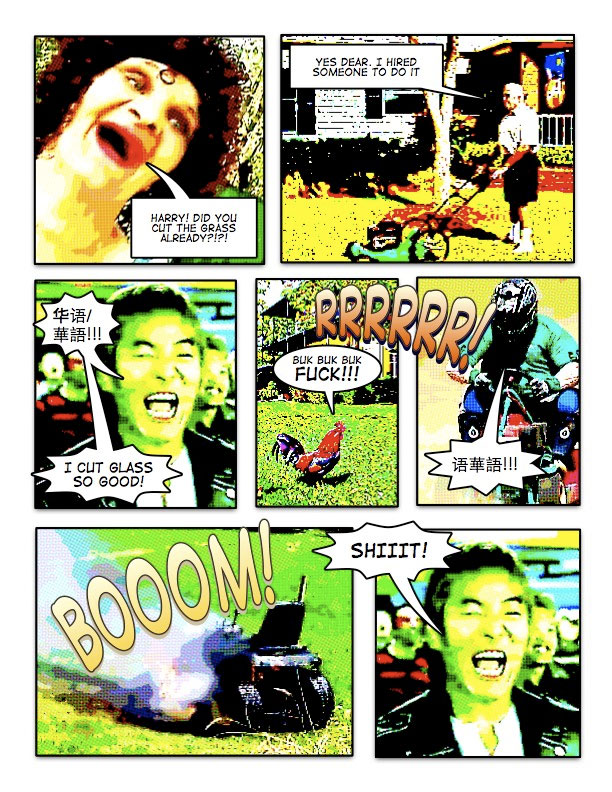
Wanta Beaver?
Here is the original comic strip Wanta Beaver? done by my friend, Gustavo.
Autumn Leaves [acoustic]
Song-by-Song: March of the Molecule Men from Flight of the Atom Bee
March of the Molecule Men was one of the last songs I wrote for Flight of the Atom Bee. I had decided that the whole album skewed to the experimental and artsy and what I really needed was a straight up easy-listening four-on-the-floor piece of ambient techno.
The problem with four-on-the-floor (a kick drum hitting each beat in the measure 1-2-3-4) is that it’s boring, so I very quickly and quite unintentionally veered off the straight and narrow with this piece.
I created the squishy bassline on my mac with an application called ReBirth that emulated the unique sound the classic Roland TB-303 Bassline synthsizer. It was a very simple pattern, four or five notes, two measures long, in D major, and it drops in and out for the course of the song. I put a slight delay on it.
I was using an Emu SP-1200 drum machine at this time. I believe I talked about it a little bit in my piece on Wild Pink Yonder. I wrote every note of the drum part – no loops were involved. In fact, I have never used drum loops or audio loops for bass lines in any piece I’ve ever written: these parts are way too important to the song and if one uses clip-art audio, one gets a clip-art song. Many of the little percussive sounds in this piece were created by hitting everyday household objects together, sampling them, editing if necessary, loading into the SP-1200 and using for percussion.
 Normally, when I arrange pieces, I block out sections and usually try to hew to an approximation of a 32-bar pop song for structure: intro-verse-chorus-verse-chorus-middle eight (or breakdown)-verse-chorus-outro. But that leaves one with a lot of room for play and exploration. Sometime I would have an event of some kind in mind and the challenge would be how to get to it in a musical and emotionally evocative manner.
My particular challenge in this piece was to build the piece rhythmically, leading up to the explosive cartoon bursts at the end.
Early on, as I worked on the piece, the cartoons of Sally Cruikshank popped in my head. I had seen a few of them at an animation festival in Berkeley in the mid-seventies and the visuals had stayed in my head for decades. So March of the Molecule Men became a soundtrack for an imaginary Sally Cruikshank cartoon. Below is one her amazing works. What an amazing and original talent. I highly recommend you buy her DVD (you can find a link to it on YouTube).
As I mentioned, I veered off the four-on-the-floor aesthetic almost immediately with this piece. Rhythmically, I was quite influenced by late Captain Beefheart here. Around the four-minute, you will hear a series of drum rolls, the first one slightly stuttered, the next a little more steady, and the last smooth and steady. This really bothered a friend of mine. I had to explain that it was the drum machine learning how to do a drum roll, that it took a couple of tries to get it right.
Now, to something very important. My good friend, Gustavo, founder of Nude Photo Music, had, around this time, informed me that a good house/techno track had handclaps on the two and the four beats. This seemed very important, so I set about creating an awesome hand clap sound. I wanted it to be BIG. I’m a little vague on what I actually did to the sound, but I know I ran it through a high-end reverb and also put some slap-back echo on it. There were probably a couple other things I did to the sound, but I cannot recall them through the mists of time.
When I published my novel, Flapping, I included a variation of the Flight of the Atom Bee cd, with some added songs, attempting to make it more commercial. In the notes on the cd at the end of the book, I said this about the clap sound:
The clap sound evolved through many steps. One could make the argument that it is the “definitive” clap sound, as well as being a perfect deconstruction of a clap, as well as being a satire of said clap, with self-referential reverb and slap-back echo.
The clap sound to this day bugs Gustavo. It is dedicated to him.
The swirling arpeggio you hear intermittently and at the very end of the piece was done with the Korg DW-8000. It’s great for such things.
All of the other sounds in the song, all the electronic noise, fragments, melodic bits, sweeps, plinks, and spurts, came from a Roland Jupiter 6, an amazing machine.
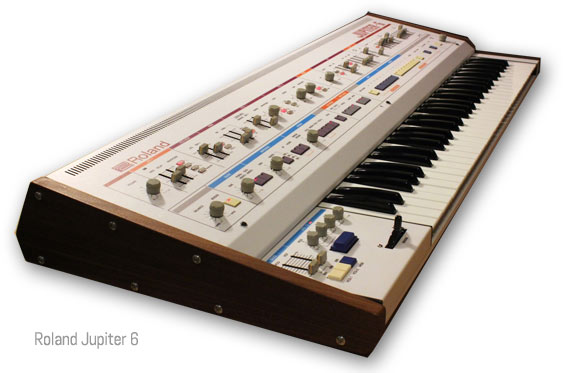
I either taped down a number of keys, or just created an arpeggio, synced via beat clock from my mac to lock to the song, and set the Jupiter 6 to hold it. I then manipulated the sound in real time, playing with attack, decay, filter settings, using sliders and knobs on the Jupiter 6 to get all sorts of strange and brightly colored—this piece is a rainbow—fragments of melody and noise. I recorded everything to digital audio tape and then transferred digitally to my mac and began the long and thoroughly enjoyable process of slicing the audio file into usable bits and moving them around, arranging and creating the flow of the piece.
I forget how many days it took to finish the song, but once I started the arranging part, I could easily work for sixteen hours, breaking for meals and coffee once in a while.
I also experimented with time-stretching sounds on this piece: you can hear the results near the climax of the composition—as is often the case, March of the the Molecule Men is about sex, the title a reference to the passage through and the eruption of bodily fluid from one body into another, to be truthful—I particularly like how certain harmonics emerge in the sounds.
So, that is how the easy-listening, almost four-on-the-four composition, March of the the Molecule Men, came to be.
“My bullshit is worth more than other people’s diamonds.”–Lou Reed
Song-by-Song: [Hydraulic] Serenity Applicator from Flight of the Atom Bee
Every week, I am publishing an article about a composition of mine, the gear, the inspiration, what was involved, and so on. I hope you enjoy them! I am enjoying writing them. —Knox
I have mentioned the Roland JX-8P Synthesizer in the pieces about Flight of the Atom Bee and The Big Shimmer. I used it to create the chordal pads that dominate both pieces. I do not recall using it on Wild Pink Yonder, for whatever reason.
There is an old maxim in the electronic music community,”New piece of gear = new track.” In other words, when you get a new piece of gear, its sounds inspire a new composition. At the time I wrote Wild Pink Yonder, I was in the end of a gear acquisition binge and that is perhaps why I didn’t use the JX-8P on that song.
The reality is that, over time, the JX-8P, even more so that the Serge Modular, became my secret weapon. I used it for pads, but even more importantly, bass sounds.

The JX-8P is one of the great under-appreciated syths, I believe largely due to its bland preset sounds and the relative difficulty in programming new sounds. It had two digitally controlled multi-waveform oscillators, a great analog filter. Programming was done with either setting one pararmeter for a sound via slider at a time, which made intuitive sound design almost impossible, or with the PG-800 Programmer.
The Pg-800 made the exploration of sound design on the JX-8P quite intuitive, but since I knew nothing in the beginning, really, about what any of the parameters did to sound, I was just blindly experimenting. The thing was, I didn’t mind spending two days tweaking a sound to get it right. All the pad sounds on The Big Shimmer and Flight of the Atom Bee were the results of such exploration. It was a form of meditation for me.
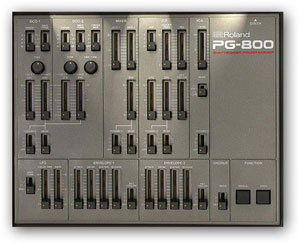
As time rolled on, I got a lot more proficient at making unique usable sounds. It has always seemed to me that the depth of the JX-8P itself worked against its popularity, but it was and is an awesome machine for those willing to spend the time building sounds from scratch. I will be talking about the JX-8P in future articles in this series: in retrospect, its sound was clearly at the core of my music composition and arranging process.
I haven’t had a JX-8P in over ten years, as of this writing in 2013, but looking at the above pictures, I find myself thinking about how nice it would be to have one again. There is now an iPad version of the PG-800, which makes the prospect quite possible.

I would have to say that the genesis of [Hydraulic] Serenity Applicator was the bass sound itself. I’m not sure what I was doing, but somehow I stumbled on this very percussive compressed bass sound which possessed very little harmonic information: it harkened back, for me, to the bass sound of Captain Beefheart’s song, Little Golden Birdies, from Clear Spot. I fell in love with it immediately and set out to write a bass line using it. You hear it in the first measure of the song.
I stretched the bass line out for a couple measures and set about writing the basic drum part, which remains pretty much the same throughout the song. I was using an Emu SP-12 drum machine at the time, a wonderful machine much love by rappers and hip-hop artist for its rhythmic feel.
It was my intention to use the same short bass part for the whole song which was beginning to take shape in my head. My thought was that, since there was so little harmonic content in the bass sound, I could just play different chords over same short repeating sequence. It almost worked, but, ultimately, I had to surrender to the musical needs of the song and modulated the bass part along with the chord changes, just like a real bass player would do.
After spending a few days building out the song, drums, bass, and the chord sequence (I still love how the first chord boldly announces itself at the third bar), it was time to add some melodic elements.
Using a system involving some archaic gear which I can’t remember, I was able to get beat-clock out of my computer into the Serge and sync a master pulse on the Serge to the song. This master pulse could be used to trigger envelopes, voltage changes, i.e., a step-generator, and so on.
I built some patch on the Serge: I honestly can’t remember which modules I used now. I started up the song and began twiddling knobs. I imagine I recorded to digital audio tape. After I got enough bits to use, I transferred them into the song file in StudioVision, editing, trimming, discarding bad parts, and began moving them around and placing them where they needed to be.
I wish I could say it was I who made the decisions, but it rarely was me at the helm when working on these songs. If I moved a piece of sound to the right spot, it would just lock into place, as if on its own. Much later, my friend Greg Jones pointed out that the song, with the walking bass line and the syncopated synth swirls, was straight-up ragtime in parts, but this was in no way a conscious decision on my part, as much as I wish I could claim it so.
In the middle dreamy part, I wanted the the Serge parts to convey an emotional arc over the melancholy chord changes. I believe I succeeded. I was always attempting to anthropomorphize my synthesizers, inserting my “hand” so to speak to evoke emotion.
Coming out of the middle part and back into the upbeat final two minutes, I had an inspiration to add a weather forecast and that is where “A few high clouds” comes from.
Somewhere in this period, I managed to overwrite the bass sound on the JX-8P and this was a real problem. I had recorded one final mix of the instrumental parts (excluding Serge parts and the weather report samples) and I was not happy with the pad sounds, which came from a Roland D-110 rackmount synth as I recall, and possibly a Korg DW-8000. I thought they were thin and lacked warmth and motion.
I spent many hours trying to find that bass sound again, using the manual programmer. Nothing else would do for this song. Alas, I could not achieve it. I could get very close, but close fundamentally altered the feel of the song, so I was stuck. All I could do was layer in a few more synth pads to thicken the mix. I wanted some shimmer, which I got from the Roland JX-8P in an overdub.
I finally got something that worked well, beautifully even, but I believed I could have made the song a little better if I could have rerecorded with a proper mix of pads. In retrospect many years later, it doesn’t matter. This is the song and it has stood the test of time.
When we were mastering this cd some years ago at Thomas Dimuzio’s studio in San Francisco, we were listening to the playback and, right around the part where the weather report comes in, I looked over and saw my friend and associate Gustavo Lanzas looking at me and shaking his head. I said,”What?”
He said,”You think this is pop music.”
I said,”Man, it’s as commercial as anything Dr. Dre puts out!”
And he said,”Yeah, right … when music goes from your ear to your brain, it passes through another dimension.”
I’m not sure if that is a compliment or not.
Lastly, I’ll break down the name of the song for you.
Hydraulic: denoting, relating to, or operated by a liquid moving in a confined space under pressure : hydraulic fluid | hydraulic lifting gear.
Serenity: the state of being calm, peaceful, and untroubled.
Applicator: a device used for inserting something or for applying a substance.
Hydraulic Serenity Applicator.
I’m sure it makes perfect sense now.
Lou Reed
Doug and Sally inside
They cookin’ for the Down Pipe
Who’s staring at Miss Rayon
Who’s busy licking off her Pig Pen
I’m searching for my mainline
I said I couldn’t hit it sideways
I said I couldn’t hit it sideways
Aw just like Sister Ray said
Whip it on.
Rosie and Miss Rayon
They’re busy waiting for her booster
Who just got back from Carolina
She said she didn’t like the weather
They’re busy waiting for her sailor
Who’s big and dressed in pink and leather
He’s just here from Alabama
He wants to know a way to earn a dollar
I’m searching for my mainer
I said I couldn’t hit it sideways
I couldn’t hit it sideways
Aw just like Sister Ray said
Lay it on him.
Cecil’s got his new piece
He cocks it shoots it between three and four
He aims it at the sailor
Shoots him down dead on the floor
Oh you shouldn’t do that
Don’t you know you’ll stain the carpet
Now don’t you know you’ll stain the carpet
And by the way have you got a dollar
On no man I haven’t got the time-time
To busy sucking on a ding-dong
She’s busy sucking on my ding-dong
Oh she does just like Sister Ray said
I’m searching for my mainline
I said c-c-c-couldn’t hit it sideways
I said c-c-c-c-c-c-couldn’t hit it sideways
Ah do it do it just su-su-su-suck
That’s ju-ju-just excellente
Oh!
Now who is that knocking
Who’s knocking at my chamber door
Now could it be the police
They come and take me for a ride-ride
Oh but I haven’t got the time-time
Hey hey hey she’s busy sucking on my ding-dong
She’s busy sucking on my ding-dong
Aw now do it just like Sister Ray said
I’m searching for my mainline
I couldn’t hit it sideways
I couldn’t hit it sideways
Oh now just like
Oh just like
Ah just like
Ah just like
Oh just like
Oh just like.
Doug and Sally inside
Now move it along
Cookin’ for the Down Pipe
Who’s staring at Miss Rayon
Do it do it do it do it do it do it
Who’s licking off Pig Pen
I’m s-s-s-searching for my mainline
I couldn’t hit is sideways
I couldn’t hit it sideways
Just like
Oh just like
Do it do it do it
Just like
Just like
Just like.
Now Rosie and Miss Rayon
They busy waiting for her booster
She’s just back from Carolina
She said she’s bound to beat a sailor
I said she haven’t got the time-time
You’re busy sucking on my ding-dong
You busy sucking on my ding-dong
Now just like Sister Ray said
I’m searching for my mainline
I said I couldn’t hit it sideways
Whip it on me Jim
Whip it on me Jim
Whip it on me Jim
Whip it on me Jim
Said I couldn’t hit it sideways
Oh do it now just like
Just like Sister Ray said.
I said now Cecil’s got his new piece
He cocks it shoots it bang between three and four
He aims it at the sailor
He shoots him down dead on the floor
Oh you shouldn’t do that
Don’t you know you’ll hit the carpet
Don’t you know you’ll mess the carpet.
Oh she hasn’t got the time-time
Busy sucking on his ding-dong
She’s busy sucking on his ding-dong
Now just like Sister Ray said
I’m searching for my mainline
Couldn’t hit it sideways
Couldn’t hit it sideways
And just like
And just like
And just like
S-Sister Ray said
Now do it to him.
Doug and Sally inside
They’re busy cooking for the Down Pipe
Who’s staring at Miss Rayon
Busy licking off her Pig Pen
I’m busy searching for my mainline
I said I couldn’t hit it sideways
I said I couldn’t hit it sideways
Now just like
Now just like
I said ah-uh
Just like
Amph-ph-ph-ph-phetimine.
Song-by-Song ~ Flight of the Atom Bee

Unfortunately, this is not the photograph of the Bee patch itself: there were five positions across several panels where banana cables were piggy-backed five-high, routing control voltages hither, thither and yon. And, of course, many more spots where plugs were stacked two-, three-, or four-high, a symphony of brightly colored spaghetti strands.
For a more detailed description of the constuction of the bee, bird, bee-thought sounds, the drone, etc., please continue reading. But first ….
Ubi Mel Ibi Apes, along with my composition 3 seconds before Maia smiled, another song built around unique analog sounds from the Serge, are in the permanent collection of the SF Museum of Modern Art, as part of Glenn McKay’s lightshow installation, Altered States. What does this mean? It means I got my name on a wall not in a public restroom for once.
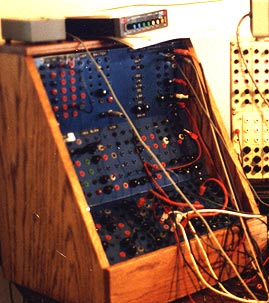
The Blue Serge
The three blue panels on the left were built by Roy Sablosky at CalArts in the late 1970’s. None of the modules had any markings whatsoever, although ins, outs, CV, and audio were color-coded. ]{This was the era where a squadron of guerilla synthfreaks surreptiously comandeered part of a building on campus to create a de facto serge assembly plant. “Built by bohemians on speed for bohemians on speed,” as Sound Transform Systems mastermind Rex Probe put it in his inimitable delicate style.}
Read Roy’s piece on the blue Serge & the Savoy Tivoli show here.
Roy, and collaborator Greg Jones, both students of Mort Subotnick, performed selections from their landmark electronic album No Imagination at the Savoy Tivoli in San Fracisco’s North Beach in the very early eighties using the blue and four-panel Serge systems. When they performed a piece of Roy’s, Forced – possibly the most acoustically violent piece of pulsed and gated white noise ever created- at top volume, the punk rockers in the audience went berserk and started screaming, pelting them with projectiles of various mass. It was not pretty. To be honest, I could empathize with the audience in this case. Forced was a brutal piece of music, an ear-shattering sonic onslaught.
The beauty of the Serge systems is the great range of sonic texture, color, and expression one can coax from the open architecture.
In the case of The Flight of the Atom Bee, the Analog Shift Register module in the center blue panel actually engendered the the whole piece. I was experimenting with it, sending bucket-brigade control voltages to an oscillator, timing pulse generated by the TR-606 drum machine (on the right of the picture) and achieved, after a time, the bee-thought cascading counterpoint which opens the song. I called Jeffrey McEachin, then known as mr808 on the Analogue Heaven mailing list, and played it for him over the phone. His response after a moment:
—It needs a space cricket sound to go with it.
I got off the phone and fiddled around or a while, unable to construct a cricket sound to my liking. And suddenly, the thought popped in my head: No, it needs a bee sound. I will always be grateful for mr808 putting me on the insectoid path to satori. I played electron slides-and-ladders for the next week to create the sonic Bee and other audio components for the piece.
In the picture above, we have (in the foreground) a Serge Touch Keyboard and a custom panel of oscillators and modifiers built by Rex Probe and crew at Sound Transform Systems in Oakland. I used the TKB for voltages to micro-tune the drone and also the filter cutoff and resonance for Atom Bee. On the panel behind the TKB I used the New Timbral Oscillator in conjunction with a Precision VC Oscillator to create the birdy sounds – modified only by a Roland Space Echo on the recording.
The Bee was comprised of three separate sounds: the buzzing of the wings, the whoosh as the bee banks left and right, and the slightly exaggerated, distorted wing-stress sound as wingtip vortices create momentary turbulence.
The four-panel box in the back was built by Serge Tcherepnin himself in the mid-seventies. On a later post, we will take a closer look at the panels, including the brown resin he poured over all the circuitry inside to protect his designs from copycats.
It was at one time in the experimental music department at Mills College in Oakland, Ca. They paid composer Greg Jones with as payment for writing a manual for their new Serge system. He paid me with it for designing a new logo for his company.
This box was the core of the Bee. The basic buzz came from one of the three old oscillators in the upper-left panel. A simple saw-tooth, modulated slightly to round-out the waveform with a rising and falling control voltage. There was also, the obvious rising and falling pitch generated by the Dual-Slope Generator over on the right. The DSG also triggered the Stepped-Function module to send out another voltage to raise and lower the over-all pitch of the buzzing bee, in steps, of course.
The distorted wing-stress sounds were made with the Triple-Wave Shaper and mixed in with VC Gates.
The Whoosh was filtered white-noise and the phase-shifter, which Greg Jones pulled out of a Mutron guitar pedal and kludged into the panel on the lower right. Also gated.
These three elements were mixed and sent out in a mono feed to another Roland Spaced Echo.
Timing pulses all generated by the Roland TR-606, which can be heard on the song. The only other sound on the song was the chord, which was made by a Roland JX-8P with the keys taped down and fed into the mixing board.
The whole Bee patch ran non-stop for over two months in the Love Shack studio. I couldn’t turn the synths off because I was afraid that if any components cooled, it would affect tone, or pitch, or timbre. Finally, hearing the Fear in my voice, mr808 flew down from Portland and helped me record the song. He also recorded a 26 minute mix which I will post at a later date, with his permission.
Recording of Flight of the Atom Bee was one live pass, mixed on the fly, using a noisy old Soundcraft mixer that had been used at Eli’s Mile High Club, a blues institution, in Oakland for many years. I hesitate to think how much whiskey and cigaret smoke adorned the circuitry of that board. We could only get one mono channel out in to this old Otari 8-track 1″ analog tape system, and even that was so noisy we had to do massive noise reduction when putting the cd together.
I cannot find my picture of the Bee patch. A shame. I will keep looking.

Dynamic Duo II
This was the photo I should have worked on. Don’t know what I was thinking when I chose the other one the first time.
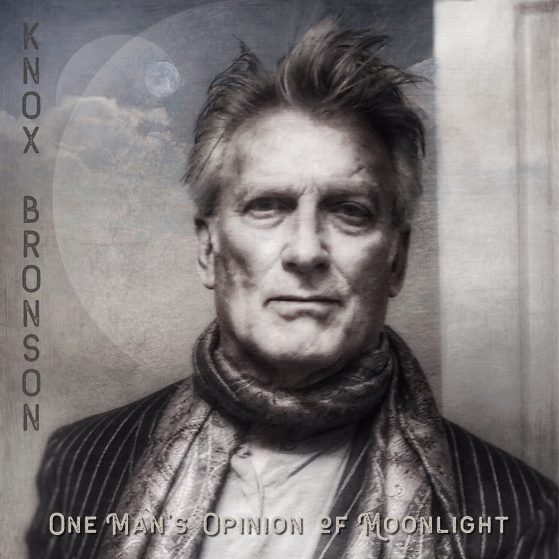
One Man’s Opinion Of Moonlight
Pop Down The Years